
Views: 90


In industrial design, it is sometimes necessary to minimize the weight of industrial products, which does not affect the original function, safety and durability, but also meet the use restrictions, which requires the introduction of lightweight design concepts. The lightweight concept originated from motorsport, its advantages are not difficult to understand, light weight, can bring better maneuverability, engine output power can produce higher acceleration. Because the vehicle is light, the acceleration performance is better at first.
With the popularization of the trend of "energy saving and environmental protection", lightweight applications are becoming more and more extensive, from general machinery manufacturing (such as robots, packaging machinery, sporting goods, etc.), energy production equipment (such as wind turbines) to automobile and aircraft manufacturing, to Construction of the space shuttle and space station. The main reason for the early aviation industry to use additive manufacturing was its light weight, as people used to compare multiple types of airline tickets when purchasing tickets, which forced airlines to work hard on fuel and energy efficiency. With 3D printing technology, there are generally three methods of weight reduction, namely, lighter shape, lighter materials, and lighter manufacturing.
Lightweight shape: To meet the stress load requirements, change the shape and transmission path of the working device. The shape optimization method utilizes the characteristics of large degree of freedom of the composite material and convenient molding, which not only reduces the quality of the parts and the body, but also prolongs the service life. The mechanical analysis is carried out by using the organism as a carrier to avoid stress concentration, so that the load is in a uniform distribution state, and the peak value is reduced by the shape change or the stress distribution is uniform. The directional design is adopted to make the reasonable distribution and orientation of the fibers, so that the portion with greater stress intensity improves the bearing capacity of the fiber, so that the secondary portion of the force is maintained at a sufficient strength.
There are four main methods for mitigating three-dimensional printing through structural design: hollow sandwich/thin-wall reinforced structure, hollow lattice structure, integrated structure realization, and heterogeneous topology optimization structure.

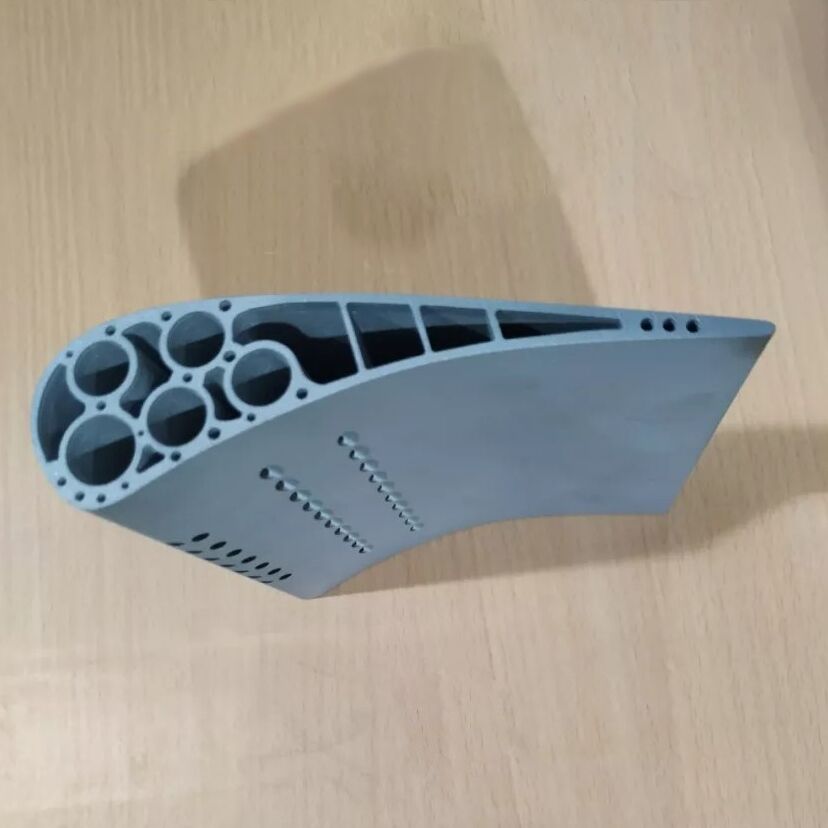
Lightweight material: better performance parameters and lower density materials. Lightweight metals and non-metallic materials are used, mainly including engineering plastics and various composite materials.
Lightweight is the easiest problem to consider as a material choice. Whether in aerospace or military companies, the demand for high-end materials is the most urgent. Not only in material selection, but also the minimum density material that meets all design requirements must be considered. It is required to have sufficient mechanical properties and even high temperature resistance, and then use 3D printing technology combined with the best process to achieve the final optimization goal.
Lightweight manufacturing: Using new manufacturing techniques to achieve less lightweight materials and a lighter design approach. For example, material-added manufacturing technology, which is a digital model file that uses a bonding material such as powder metal or plastic to construct an object by layer printing. Three-dimensional printing is lightly structured from its unique manufacturing method. The feasibility of quantification.
“This disruptive technology provides tremendous advancements in how we can develop components for our future vehicles to make them lighter and more efficient. When we pair the design technology with manufacturing advancements, such as 3D printing, our approach to vehicle development is completely transformed and is fundamentally different, [It enables us] to co-create with the computer in ways we simply couldn’t have imagined before. The technology is key to developing efficient, lighter alternative propulsion and zero emission vehicles. It provides significantly more vehicle mass reduction and parts consolidation opportunities that cannot be achieved through traditional design optimization methods.” says Ken Kelzer, GM vice president of global vehicle components and subsystems.
This company has more than 50 3D printers and has produced more than 250,000 prototype parts over the past decade. As part of a multi-year collaboration focused on innovation, GM and Autodesk will collaborate on projects involving the generation of design, 3D printing and materials science.
